Thinner Lenses
Lens thickness depends on your prescription, frame choice, lens design, and lens material.
If you are worried about thick or heavy lenses, there are several ways we may be able to help. Thinner lens materials, aspheric lens designs, and careful frame choice can all make a difference.
The best option depends on your prescription, the frame you choose, and what you want to achieve with the finished glasses.
What affects lens thickness?
- Your prescription strength
- Whether you are short-sighted or long-sighted
- The size and shape of the frame
- How centred your eyes are in the frame
- The lens material or index
- Whether the lens design is spherical or aspheric
- The lens edge and frame type
There is more to thin lenses than lens material
High-index lenses can help reduce thickness, but frame choice is often just as important. A very large frame can make lenses thicker even when a thinner material is used.
Prescription
Stronger prescriptions generally create thicker lenses. Short-sighted lenses tend to be thicker at the edges, while long-sighted lenses tend to be thicker in the centre.
Frame size
Smaller, well-centred frames often help reduce lens thickness and weight, especially for higher prescriptions.
Lens material
Higher index lens materials bend light more efficiently, which can allow the lens to be made thinner than standard materials.
Frame choice can make a big difference
For many stronger prescriptions, choosing a smaller frame that keeps your eyes well centred can reduce thickness more effectively than choosing a very large frame and relying only on thinner lens material.
Two common thinner lens options
Aspheric lenses and high-index lenses. Both can be useful, depending on the prescription and frame.
Aspheric lenses
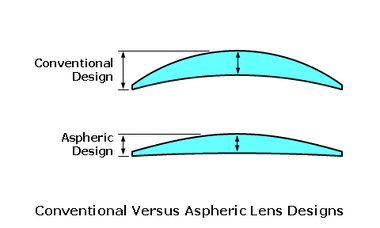
Aspheric lenses have a flatter lens design than traditional spherical lenses. This can make some lenses thinner, flatter, and more natural looking.
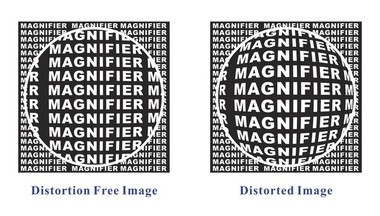
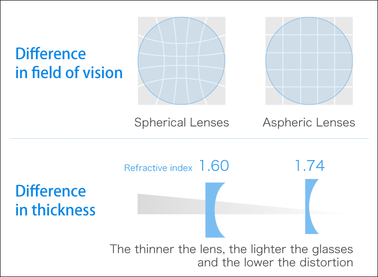
Aspheric designs may also reduce some unwanted magnification or distortion effects, especially in certain plus prescriptions.
High-index lenses
High-index lenses use materials that bend light more efficiently than standard plastic lenses. In many prescriptions, this allows the lens to be made thinner and sometimes lighter.
The higher the index, the thinner the lens may be, but the benefit depends on your prescription, lens size, frame choice, and lens design.
Thinner does not always mean better
The thinnest lens is not automatically the best choice. Higher-index lenses can cost more, may have different optical properties, and may not provide a noticeable benefit for every prescription.
We will explain whether a thinner lens option is likely to make a useful difference for your glasses before recommending it.
How prescription type affects thickness
The way a lens becomes thick depends on the type of prescription.
Short-sighted prescriptions
Myopia, or short-sightedness, usually creates lenses that are thinner in the centre and thicker at the edges. Larger frames often make this edge thickness more noticeable.
Long-sighted prescriptions
Hyperopia, or long-sightedness, usually creates lenses that are thicker in the centre. Lens design, frame size, and accurate centration can all affect the final appearance.
Practical ways to reduce lens thickness
The best result usually comes from combining good lens choice with good frame choice.
Choose a suitable frame size
A smaller frame can often reduce edge thickness and weight, especially for short-sighted prescriptions.
Keep the eyes centred
Frames where your eyes sit close to the centre of the lenses can help reduce unnecessary thickness.
Use the right lens material
High-index lens materials may reduce thickness, especially for moderate to higher prescriptions.
Consider aspheric design
Aspheric designs can help some lenses look flatter and thinner, depending on the prescription.
Avoid unsuitable large frames
Oversized frames can make lenses thicker, heavier, and more visually noticeable in stronger prescriptions.
Get accurate measurements
Good fitting measurements help ensure the lenses are made and fitted properly in the frame.
We will help you balance appearance, comfort, and cost
Thinner lens options can be worthwhile, but the most expensive option is not always necessary. We will explain the likely difference so you can make a practical decision.
Will thinner lenses remove all thickness?
Not always. Strong prescriptions may still have some visible thickness, especially in larger frames. The aim is to reduce thickness where practical, not to promise invisible lenses.
Are high-index lenses always lighter?
Not necessarily. Some higher-index materials are denser than standard materials, so the final weight depends on prescription, lens size, and material choice.
Do thinner lenses need anti-reflection coating?
We usually recommend a good anti-reflection coating with many high-index lenses because these materials can show more reflections without coating.
Can I use thinner lenses in any frame?
Often, but not every frame is suitable for every lens or prescription. We will check frame size, shape, fit, and lens suitability before you decide.
Want advice on thinner lenses?
You can book online, phone us, or call in and see us at Waipapa Eyecare.
For urgent eye problems, sudden vision changes, flashes, floaters, eye pain, or injury, please phone us rather than using online booking.